In short: Automated penetration testing uses software to find and exploit weaknesses on a repeatable schedule. This guide explains how it differs from manual testing and scanning, what automation cannot do, how to implement it, and where autonomous testing goes next.
Automated penetration testing uses software to discover assets, identify weaknesses and safely attempt exploitation on a repeatable schedule, so testing no longer waits for the next consultant engagement. Its newer form, autonomous penetration testing, goes further: it decides which weaknesses to chain together and proves how far an attacker could get.
How is automated pentesting different from a manual pentest?
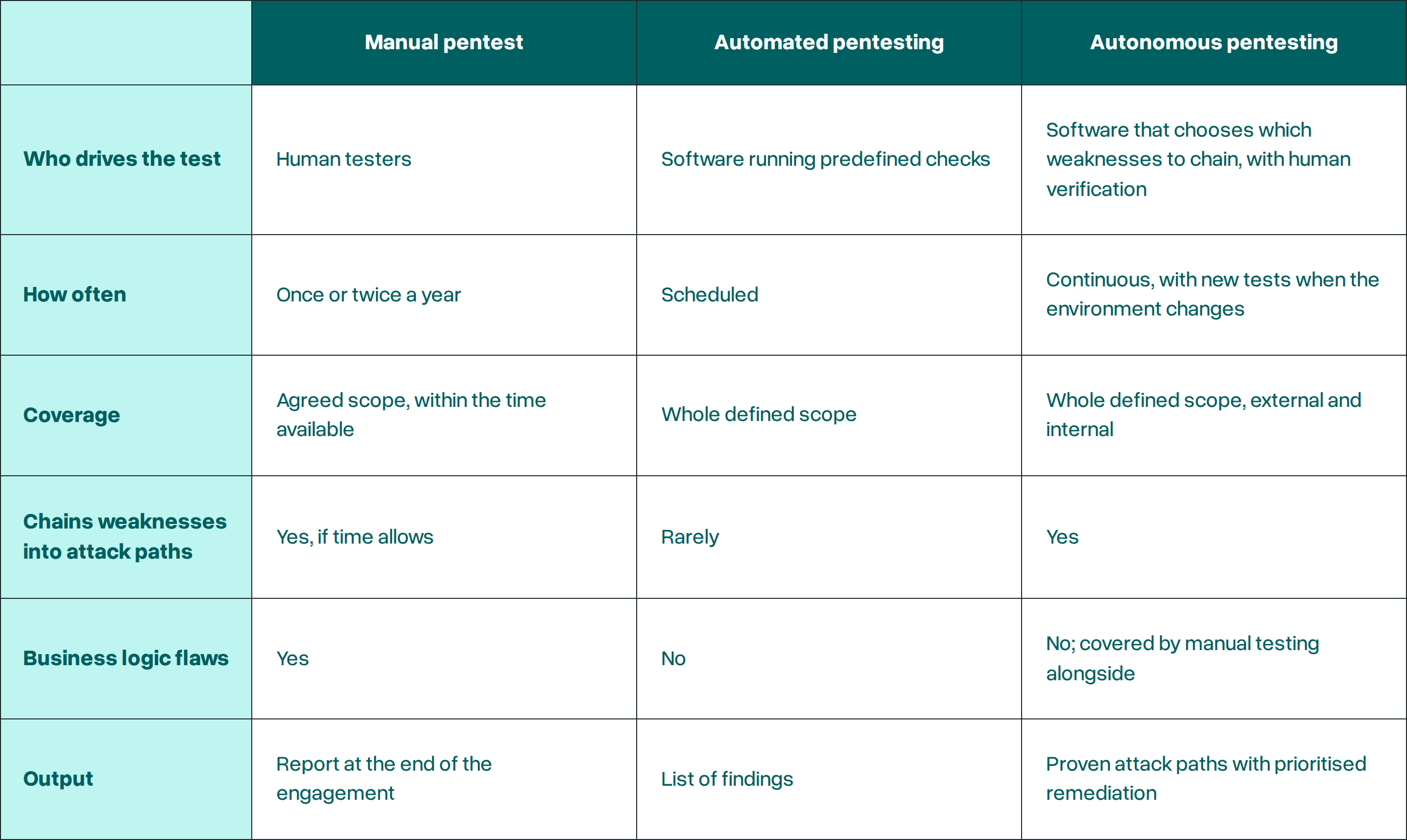
A manual pentest is a human-led, time-boxed engagement; automated pentesting repeats the discovery and exploitation steps continuously, so people can focus on the work that needs judgement.
How is automated pentesting different from vulnerability scanning?
A vulnerability scanner reports what might be vulnerable; automated pentesting attempts to exploit it, which shows whether the weakness is real and what it leads to.
That difference decides what a team works on. A scanner hands over thousands of findings ranked by severity score. Exploitation turns them into a handful of proven risks. Done properly, exploitation is payload-less: each attempt is constrained to the specific weakness being tested, so impact is proven without deploying malicious code or putting production systems at risk.
Why should you consider automated pentesting?
Because your attack surface changes every week, and an annual pentest describes it accurately for only a few of them.
- It closes the gap between tests. Traditional testing validates one moment in time. Attackers exploit what changed afterwards: a new cloud service, a widened integration permission, a vulnerability disclosed the week after the report.
- It covers the whole scope every time. A manual test samples what it can in the days available. Automation runs the same depth across every in-scope asset, every cycle.
- It prioritises by proof. Findings that have been exploited go to the top of the remediation queue. Findings that could not be exploited stop competing for attention.
- It frees human testers. Repetitive discovery and known-weakness checks move to software, and people spend their time on business logic, scoping and judgement.
What can automation not do?
Automation cannot understand your business, so some testing still needs people.
- Business logic flaws. A discount that can be applied twice, or an approval step that can be skipped, depends on how your workflows are meant to behave. Software does not know that.
- Scoping and priorities. Deciding what matters most, and what must not be touched, is a business decision.
- Business impact. Software can prove an attacker reaches a server. A person explains what losing that server means for you.
- Verification. Someone has to confirm a finding is real before a team spends a week fixing it.
This is why, at Hackurity, every finding is verified by our own red team before a customer sees it, and why the autonomous stack runs alongside quarterly manual testing rather than replacing it.
How do you implement automated pentesting?
Define what is in scope, decide where testing starts, agree the rules, and connect findings to the people who fix them.
Set your targets. List the domains, IP ranges, applications, APIs and environments in scope. Include the ones nobody owns any more: forgotten assets are where attackers start.
Decide where testing starts. External testing shows what an attacker on the internet could reach. Internal testing starts from inside the network and shows how far an attacker with a foothold could move. Most organisations need both.
Agree the rules of engagement. Which systems are sensitive, which hours are off limits, who is told when a critical path is found, and what "safe exploitation" means in your environment.
Route findings to the people who fix them. Decide whether remediation runs from the dashboard, scheduled reports or the API into your ticketing workflow, and who owns each asset.
Keep human testing for what needs judgement. Schedule manual testing for business logic and high-value applications.
Retest every fix. A fix is finished when the attack path no longer works, not when the ticket closes.
Is automated pentesting the future of penetration testing?
Automation is the future of the repetitive parts of penetration testing, not of the tester.
Early tools sold the idea as push-button pentesting: press a button, receive a report. In practice many of them were scanners with a new label, because they stopped at discovery. The direction now is autonomous testing that exploits and chains weaknesses the way an attacker would, with human experts verifying the results. Speed comes from the software; trust in the findings comes from the people.
How does Hackurity approach automated penetration testing?
Hackurity delivers it as Managed Autonomous Pentesting (MAP): autonomous penetration testing, which is what we used to call automated pentesting.
MAP works in six stages: target input, asset discovery, vulnerability identification, safe exploitation, post-exploitation and impact analysis, and a business-contextualised risk report. It comes in two variants. exMAP tests the external attack surface from the internet; inMAP tests from inside the network. Exploitation is payload-less and constrained to the weakness being tested.
All technology is built in-house. Every finding is verified by our red team, who then work directly with yours on remediation, and quarterly manual testing covers what automation cannot.
Related questions
Is automated pentesting safe to run against production systems? It is when exploitation is payload-less and constrained to the weakness being tested, so impact is proven without deploying code or disrupting services.
How often should automated pentests run? Continuously, with new tests triggered when the environment changes, and a retest after every fix.
Does automated pentesting replace manual penetration testing? No. It replaces the repetitive parts. Business logic, scoping and verification still need people.